—– Measurement Systems / Density
Reliable Density Measurement for Difficult Liquids and Slurry
Non-contact radiometric, or nuclear, measurement accurately measures density or percent solids, without bypass lines, wetted components, or process interruptions, even in abrasive, corrosive, high-temperature, or variable-density service.
THE MEASUREMENT CHALLENGE
Density instruments must perform in changing, often abrasive processes
Conventional density devices can be affected by slurry abrasion, corrosion, viscosity, high temperature, process pressure, and changing solids content. Inline instruments may require bypass lines, intrusive components, or regular maintenance, adding cost and potential leak points to the process.
THE RONAN APPROACH
Measure density through the pipe or vessel wall
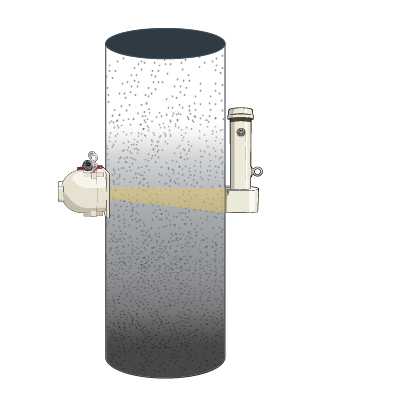
Ronan density systems mount externally on the pipe or use dry-well configurations where appropriate. The system measures the attenuation of gamma energy through the process. As density changes, the detector receives a corresponding change in energy, and the microprocessor converts it into density, specific gravity, percent solids, or another selected engineering unit.
HOW IT WORKS
Three coordinated components create a density measurement.
STEP 1
The source holder directs energy through the process.
The measurement path is designed around pipe geometry, wall thickness, and the density range to be measured.
STEP 2
The detector senses density changes.
Denser material attenuates more energy, changing the signal received by the detector.
STEP 3
The microprocessor converts the signal into selected density output.
The X96 microprocessor filters and correlates the signal to the selected density, percent-solids, or specific-gravity output.
The system is engineered around the process and measurement requirements
Ronan evaluates the pipe or vessel size, wall material and thickness, expected density range, process temperature and pressure, and available installation access to determine the measurement geometry.
What determines the density measurement configuration:
- Pipe diameter, wall thickness, liners, and insulation
- Expected density range and laboratory reference values
- Process temperature, pressure, flow conditions, and vibration
- Material buildup, entrained gas, changing solids content, and required response time
When external density measurement matters
The system is configured so that it does not come into contact with the process. The measurement remains stable because instruments are not affected by or exposed to wear, buildup, or difficult process conditions.
Common density applications
- Slurry density and percent-solids measurement
- Dredging and mining process lines
- Chemical process liquids
- Pulp, liquor, and paper-processing streams
Industries
See applications and process challenges:
Need help with your measurement application?
Ronan will work closely with you to develop a reliable measurement solution for your most challenging process applications.
If you need immediate assistance, please contact us directly.
About
For more than 60 years, Ronan Engineering has manufactured reliable and leading-edge instrumentation systems. As providers of real-time monitoring and measurements of critical process control points, Ronan has kept some of the world’s largest plants, factories, and facilities running safely and efficiently. Ronan has established manufacturing, sales and service facilities in Kentucky and the United Kingdom.