
—– Measurement Systems / Point Level
Dependable Point Level Detection at Critical Process Control Points
Radiometric, also known as nuclear, measurement allows you to reliably detect material at a defined point in tanks, hoppers, chutes, and process pipes without exposing a probe or switch to the process.
THE MEASUREMENT CHALLENGE
Point-level switches are often installed where conditions are most severe
High- and low-level alarms are critical control points, but conventional switches can be damaged or fouled by abrasive solids, sticky material, corrosion, pressure, heat, or buildup. When a switch fails, it can create false trips, missed alarms, production interruptions, and require difficult maintenance inside the vessel.
THE RONAN APPROACH
Detect material without inserting a switch into the process
Ronan point level systems mount externally, with a source holder and detector positioned on opposite sides of the tank or vessel, at the required alarm or control elevations. When material enters the measurement path, it attenuates the beam reaching the detector. The system identifies that change and provides a dependable point-level signal for alarms, interlocks, or process control.
HOW IT WORKS
Three coordinated components detect material at a defined elevation.
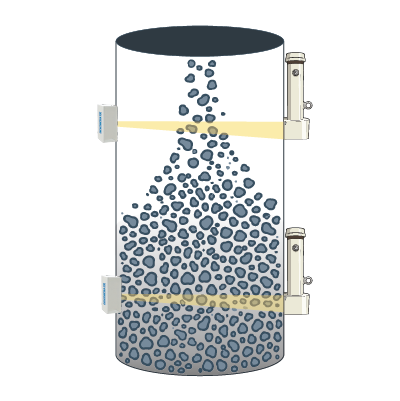
STEP 1
The source holder establishes the sensing point.
The source holder directs a focused beam across the vessel, chute, or pipe at required high-, low-, or control-level positions.
STEP 2
The detector senses a change in the beam.
When process material enters the path, it reduces the energy received by the detector.
STEP 3
The microprocessor provides a control signal.
The X90 monitor evaluates the change and sends a point-level output to the control system, alarm, or interlock.
The system is engineered around the process and measurement requirements
Ronan defines the sensing elevation, vessel or pipe geometry, wall thickness, material characteristics, and required switching logic before selecting the source holder, detector, and monitor configuration.
What determines the point level configuration:
- Required alarm, interlock, or control elevation
- Vessel, hopper, chute, or pipe geometry
- Wall thickness, insulation, refractory, and mounting access
- Material density, buildup, flow behavior, and expected process changes
The benefit of non-contact point level measurement
A properly configured external point-level system can provide a dependable control point without adding a wetted switch, probe, or moving component to the process.
Common point level applications
- High- and low-level alarms in hoppers and bins
- Plugged-chute detection
- Point-level detection in tanks and process pipes
- Fly ash, powder, bulk solids, and difficult liquids
Industries
See applications and process challenges:
Need help with your measurement application?
Ronan will work closely with you to develop a reliable measurement solution for your most challenging process applications.
If you need immediate assistance, please contact us directly.
About
For more than 60 years, Ronan Engineering has manufactured reliable and leading-edge instrumentation systems. As providers of real-time monitoring and measurements of critical process control points, Ronan has kept some of the world’s largest plants, factories, and facilities running safely and efficiently. Ronan has established manufacturing, sales and service facilities in Kentucky and the United Kingdom.